Hugues
The Best Werewolf Short Stories 1800-1849Hugues is the faithful squire and vassal of the Sire of Keridreux, but his service is inseparable from a harsher identity: he belongs to the Hugues Wulfric family, a persecuted lineage whom their Anglo-Saxon neighbours regard as descended from wer-wolves. He therefore occupies two contradictory positions at once. Within the castle he is a trusted factotum, body squire, and feudal valet; beyond it he is treated as an accursed outsider whose name is blamed for misfortune. His comic adventures conceal a life shaped by poverty, inherited stigma, and the constant need to survive other people’s fear.
Identity and Background
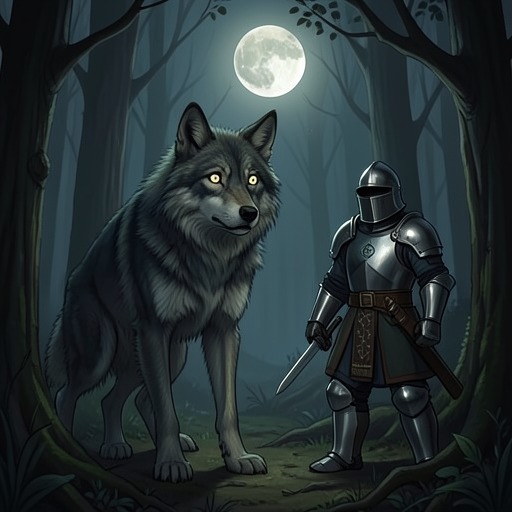
Hugues comes from a Norman family living in a miserable, isolated hut in the Weald of Kent, between Ashford and Canterbury. The Wulfrics have been rejected for generations because the surrounding population believes that a lycanthropic stain has passed from father to son. Fires, ruined barns, storms, blighted grain, diseased cattle, illness, and premature childbirth are all attributed to them, so that the family is treated almost as ferae naturae rather than as ordinary human neighbours.
The family’s exclusion is both social and institutional. The Wulfrics avoid the highways and the town of Ashford, do not attend Canterbury market or the shrine of Becket, and take no part in communal labour or festivities. The priest has barred them from communion, while the men of the tavern exclude them from ordinary fellowship. Hugues does not actively refute the accusations because he knows both that they are false and that he lacks the power to make anyone believe him. His silence is therefore not an admission of guilt but a survival strategy under conditions of social ostracism.
His material circumstances become catastrophic after the death of his parents and two younger sisters. He buries his parents himself, using hempen shreds as grave clothes and only a few clods of earth to mark the resting place; later, his sisters also die within a fortnight. Winter prevents work in the woods and fields, and neighbouring farmers refuse to hire him because they fear the supposed fatality attached to the Wulfric name. He is taunted, threatened, attacked by dogs, and denied even the alms ordinarily given to professional beggars. Hunger and grief bring him close to suicide, but love gives him a reason to continue living, preserving the last human attachment in a life otherwise reduced to resentment and isolation.
Service at Keridreux
Hugues’s position changes when he becomes the servant of the Sire of Keridreux. His duties extend beyond ordinary attendance: he supervises the knight’s dress and toilet and acts as a body squire or feudal valet. Even in the castle, however, his dependence remains visible. After the river incident, he stands edgewise to his master, watching both the angry lord and the open door, ready to flee at a word or glance. The posture captures his whole condition: loyalty is real, but so is the reflex of a man accustomed to punishment.
The knight’s treatment of him is volatile. During a public bathing spectacle, the Sire of Keridreux orders Hugues into the river to protect the honour of the house. Hugues protests that he cannot float, and the knight, enraged by the crowd’s laughter and resistance, drags him to the water’s edge and threatens to throw him into the stream. When the blow comes, Hugues instinctively catches his master’s doublet; both men fall into the river. The current carries Hugues away, saving him from the knight’s sword, while the crowd jeers at him. His fear produces the accident, but his sudden grip also prevents the immediate violence intended against him.
The aftermath reveals a complicated dependence rather than simple hatred. The Sire of Keridreux blames Hugues for the humiliation, yet later speaks to him with sorrow as well as anger, lamenting that a man who has eaten his bread and drunk his cup should have served him such an unrighteous turn. Hugues remains beside him, helps him rise, and listens as he recounts his misfortunes over hippocras. The relationship is unequal and often abusive, but it also gives Hugues shelter, employment, and a place within a household from which the wider society has excluded him.
The Mission to Ploërmel
The central crisis begins when the Sire of Keridreux fears that, at twilight, he will be forced to resume the nightly character of a loup-garou. A consultation decides that Hugues must ride to Ploërmel with a letter requesting the immediate presence of Father Etienne, the knight’s confessor. The proposed remedy is explicitly religious: prayers and anathemas are expected to prevent the transformation. Hugues is told to ride for life and death and to bring the slow-moving priest back on a pillion behind him.
The mission is complicated by the Dame of Keridreux, who insists on knowing the reason for every departure. Hugues conceals the pillion under an old cloak and leaves, but she stops him with a second memorandum for Father Bonaventure, her own confessor. He cannot read, and the two letters are made indistinguishable by the knight’s failure to use the customary seal and address. At the oak of Mi-voie, Hugues discovers the mistake and, fearing the dame’s anger, decides to present both letters to Father Etienne if necessary. His illiteracy is treated comically, yet it has serious consequences: he is made the courier of a plot whose written instructions he cannot decipher.
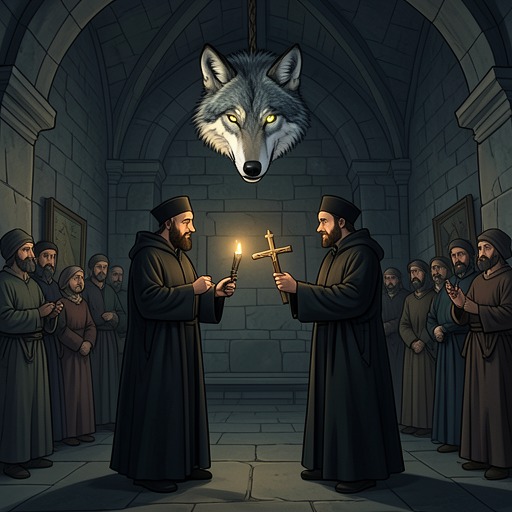
At Ploërmel, the two rival monks repeatedly evade one another, each apparently concealing a private connection with the Dame of Keridreux. The sun sets while Hugues waits, and the warder’s horn turns his anxiety into panic because he believes his master will be left in the forest, stripped naked before the change. When Father Etienne finally approaches the horse, Hugues loses patience. He lifts the monk bodily onto the saddle, jumps onto the pillion, and gallops away, committing the comic but literal offence of stealing a churchman. Father Bonaventure follows, creating a frantic pursuit in which secrecy, jealousy, religious authority, and Hugues’s desperate loyalty become indistinguishable.
The Bundle and the Apparition
The confusion continues when Father Bonaventure gives Hugues a bundle to return to the Dame of Keridreux. Hugues, having spent the day riding from convent to convent and seeking spiritual aid, accepts the deposit after being assured that the monks’ efforts will serve his master. On the road home, he notices a projecting corner and gradually recognizes the bundle as the same one he had strapped to his horse the previous night. Curiosity overcomes obedience: he opens it and discovers the lost suit of the knight’s clothes.
Instead of continuing directly to the castle, Hugues changes course and deposits the bundle on a perpendicular stone at the edge of the forest. There he hears a strange sound, sees part of an apparent subterranean arch collapse, and recoils from a snow-white human form rising silently from the earth. He flees, then forces himself to return and sinks fainting at the stone. When the howling of wolves wakes him, he sees the Sire of Keridreux standing stark naked before him. The figure takes the clothes, dresses calmly, and kicks Hugues for having participated in the supposed cabal.
Hugues’s testimony preserves the supernatural interpretation of the episode while also exposing its comic instability. He insists that he had believed the apparition to be a loup-garou and had brought the clothes because some treasonous enemy had stripped his master. The scene turns his habitual fear of the werewolf label into a moment of mistaken recognition: the man stigmatized as a possible monster becomes the terrified witness who mistakes his master for one. His courage consists not in mastering fear but in returning to the stone, investigating what he saw, and completing the task despite the possibility of supernatural danger.
Loyalty, Recognition, and Narrative Role
After the affair, the Dame of Keridreux leaves for a distant country with her Latin-speaking monk, while the knight eventually courts Beatrix successfully. Father Etienne withdraws from further involvement with so dangerous a family, and Hugues is relieved to lose the bundle from his thoughts. His standing within the household improves daily, however, and he becomes increasingly valued by both master and mistress.
Hugues also becomes the recurring witness who keeps the story alive. Whenever the knight tells the tale of his translation into a loup-garou after supper, Hugues resumes the narrative at the passages where he himself appeared. He is thus not merely a participant but a secondary narrator, turning personal testimony into household folklore. His version reinforces the knight’s account even as the surrounding uncertainty undermines it.
The narrative never settles whether the supernatural adventure truly occurred. It remains possible that the knight imagined the transformation, or that neighbours engineered the spectacle; another explanation holds that he was imprisoned in his own castle by the fraud and force of a wicked priest and an unfaithful wife, then escaped and recovered his clothes without ever becoming a loup-garou. Hugues does not resolve these alternatives. His role is instead to embody the story’s unstable border between evidence and superstition: a man whose life has been damaged by a werewolf accusation nevertheless helps preserve another man’s possibly imaginary werewolf legend.
Hugues’s importance lies in this tension. His low social status gives him access to the secrets of the castle, while his illiteracy and dependence make him vulnerable to schemes devised by people above him. He is repeatedly pushed into danger by rank, religion, and domestic intrigue, yet he responds with speed, practical intelligence, and stubborn devotion. The supposedly accursed outsider becomes the household’s most reliable messenger and witness, making him both the comic engine of the plot and its clearest demonstration that labels imposed by superstition can distort every human relationship around them.